The story
Duns, Scotlandc. 1266
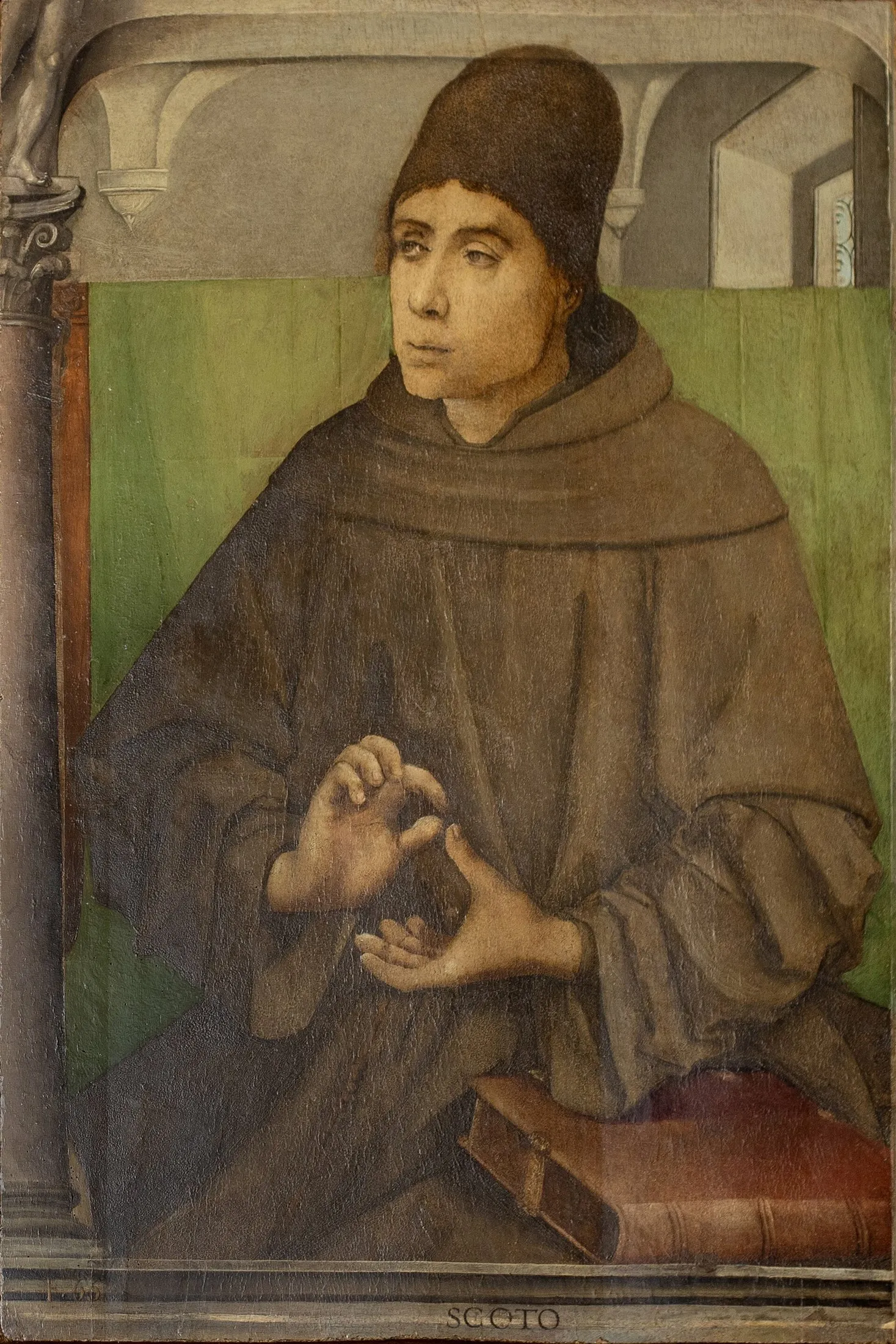
John Duns Scotus was born in Duns, a small town in the Scottish Borders, and had one of the sharpest minds of the medieval universities. A Franciscan friar, he taught at Oxford, Paris and Cologne, and died at about forty-two with most of his work unfinished. His contemporaries called him Doctor Subtilis, the Subtle Doctor, because nobody drew distinctions as finely as he did.
He argued that “being” means the same thing whether said of God or of a stone, which sounds dull and was dynamite. He coined haecceity, the “thisness” that makes a thing this thing and no other, a concept philosophers still use. His argument for the Immaculate Conception became Catholic dogma in 1854, five and a half centuries after his death. He was beatified in 1993. For two hundred years his followers, the Scotists, were a dominant school in the universities of Europe.
The gap
Then the universities changed hands. In the early 1500s the humanists and the reformers went to war on scholasticism, and the Scotists were the establishment: the men defending the old logic against Greek, Hebrew and what was proudly called the New Learning. A “Duns man” became a jeer for someone who splits hairs and cannot learn anything new. By the 1570s “dunce” had lost even that much precision. It meant, simply, a dim student.
So the name of the man famous for being too clever became the word for being too stupid. The insult is a fossil of a culture war, and the losers of the war became the word. The pointed cap, incidentally, is a nineteenth-century addition with no good link to Scotus at all. The story that he prescribed conical hats to funnel wisdom into the skull is exactly the kind of tidy legend this site exists to check.